Showing posts with label Time Traveler: 1200s. Show all posts

Sunday, December 22, 2013

Sisters of the Bruce, 1292-1314 by J.M. Harvey

Rating: ★ ★ ☆ ☆ ☆
Obtained from: Netgalley
Read: November 7, 2013

Set against the wild and perilous background of Scotland in the late 13th century, the adventurous lives of Robert the Bruce’s five sisters come to life through their own words in a series of letters. Courage and tenacity are often associated with Scotland’s great hero, but few appreciate the enormous challenges experienced by these remarkable sisters. Their intimate account of family life resonates still with love, loss and hope. Isa leaves home to sail to the land of the Vikings to become Queen of Norway whilst her sister, Kirsty, finds herself Countess of Mar and chatelaine of the great Kildrummy Castle in Scotland’s far northeast. Danger looms and the younger sisters, Mathilda and Margaret, escape to Orkney with Kirsty’s children. As Scotland spirals into war, Robert’s sisters face the wrath of King Edward of England, whose vengeance wrought the brutal death of William Wallace. Kirsty is incarcerated alone in an English nunnery, whilst Mary endures years of misery within a cage hanging from the walls of Roxburgh Castle. Under Robert’s kingship, old wounds heal and Scotland’s fighting force achieves a resounding victory at the Battle of Bannockburn. Only then are the fragile, traumatised women released, through the ransoming of English nobles, to return home to rebuild their shattered lives… Sisters of The Bruce is a captivating work of fiction that weaves family history with a gripping narrative through the social and political landscape of medieval Scotland, Norway and Orkney. J. M. Harvey has been inspired by Sharon Penman, Elizabeth Chadwick and Sigrud Undset.

════════════════════════════ ❧  ════════════════════════════

Despite my intense interest in the subject matter, J.M Harvey's Sisters of the Bruce didn't work for me. The content had potential, but the style and mechanics of the narrative were so awkward and unpolished that I found it impossible to enjoy the time I spent reading the book.

In looking at my notes, I think my difficulties stem from Harvey having bitten off more than she could chew. The language/prose is tedious and dry, the overall tone left me indifferent to both her characters and their experiences and I was greatly disappointed by the story's lack of theme. The author did not properly develop her cast, relies heavily on macro level conflicts - practically ignoring those personal arcs that would have added depth to the narrative - and pads out the text with an excessive amount of filler.

All told, the end result doesn't feel like fiction. A dense fact-based rehash of the trials and tribulations suffered by Robert and his siblings, the narrative lacks the spirit and dimension I associate with this particular genre and fails to achieve the promise touted so prominently in the jacket description. 

════════════════════════════ ❧  ════════════════════════════
Never had our violent past seemed so real. If I was to flourish as Queen of Norway, it would serve me well to follow Grandfather's creed. Fierce courage had been his greatest defense. 
════════════════════════════ ❧  ════════════════════════════

Sunday, October 6, 2013

The Outlaw Knight by Elizabeth Chadwick

Rating: ★ ★ ★ ★ ★
Obtained from: Netgalley
Read: October 2, 2013

Fulke FitzWarin has played many roles -- loyal knight, dangerous outlaw, dashing lover, loyal husband. But when a violent quarrel with King John disrupts Fulke's ambition to become Lord of his own castle, his true character as a valiant hero is revealed.

════════════════════════════ ❧  ════════════════════════════
How does one describe reading Chadwick? I began contemplating the question when I received The Outlaw Knight for review and even after reading the book the only thing I'm sure of is that I am incapable of doing justice to the author or her work. 

Do you start in with the emotional beauty of her stories? Give comment on the range and depth she portrays in John's petulant outbursts, Jean's brotherly affection and William's stubborn pride? Or it is better to highlight the intricate complexities of the interrelationships her characters enjoy, for example the fraternal loyalty shared by Theobald and Hubert or the steadfast devotion that exists between Fulke and Maude. 

Of course one can't forget the author's obvious attention to detail. Close your eyes and you can picture the stable yard at Alberbury, the garrison at Whittington and even the salting larder at Shipley. Honestly, Chadwick takes scene building to an entirely different level, immersing her readers in the world her characters inhabit by crafting a vivid and comprehensive portrait of medieval life within the confines of a fictional narrative. I don't often agree with promotional endorsements, but Sharon Kay Penman was spot on when she declared these books the next best thing to time travel. 

Then again, perhaps it is best to go in an entirely different direction and describe Chadwick's gift for storytelling. Her ability to manipulate both history and mythology in the tale of a marcher lord who becomes an outlaw, tames Welsh dragons, slays Irish serpents and defies his king in the name of honor, justice, chivalry, and pride. 

When all is said and done, I suppose it doesn't matter. For years I've made due shoving Chadwick's books at my friends with the terse order to read and thank me later. It isn't a particularly articulate recommendation, but it seems to work well enough. Suffice it to say that true to form, The Outlaw Knight, is a wonderfully addictive read. A beautiful story you can't help but fall in love with. 

*Note: This title was previously published as Lords of the White Castle. 

════════════════════════════ ❧  ════════════════════════════
"By God on the Cross and the Devil in the pit of hell, I will give Fulke FitzWarin and his brothers the justice of common law," he choked. "I will have them strung from the gibbet on Whittington's battlements and they can gaze on their land from from there!"
════════════════════════════ ❧  ════════════════════════════

Sunday, July 29, 2012

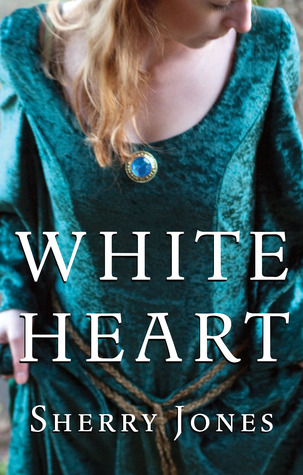
White Heart by Sherry Jones

Rating: ★ ★ ★ ★ ☆
Obtained from: Personal Kindle Library
Read: July 28, 2012

A woman's power lies in her beauty. For years, Blanche de Castille, the White Queen of France, has lived by this maxim—passed on by her grandmother, ElÉonore d'Aquitaine, as she took the girl to marry King Louis VIII. When her husband dies unexpectedly, however, Blanche finds that beauty is not enough to hold, and command, a kingdom against usurpers eager to wrest the Crown from her woman's grasp. Faced with an English invasion, barons' uprisings, and slanderous rumors, Blanche must look within herself for the strength she needs to guard the throne for her young son. Her bold response shocks the kingdom and shapes her into the formidable, seemingly heartless mother-in-law to Marguerite of Provence, wife of King Louis IX (Saint Louis) and the eldest of the "Four Sisters, All Queens" in Sherry Jones's forthcoming novel.

═══════════════════════════ ❧  ═══════════════════════════

I finished Sherry Jones' White Heart yesterday and my head is still spinning. See, I hadn't planned on revisiting the Capets so soon after reading Sophie Perinot’s Sister Queens. Not being overly familiar with the family, I had hoped to do a little research of my own before attempting another fictionalized account of their history. Oh well, best laid plans right?

I had never even heard of Blanche prior to reading Sister Queens and I was quick to grow annoyed with the bitter, manipulative, controlling dowager Perinot created. It wasn’t until reading Jones’ novella that I bothered giving 'the dragon' much thought. Who was this woman? Where did she come from? What sort of hand had life dealt her? It is a testament to both Jones’ imagination and pen that I could so quickly alter my opinion of the French Queen, even more so as her novella is only fifty eight pages long.

Jones doesn't elicit the reader's sympathy by portraying a vulnerable or demure widow. Rather, she sparks their curiosity, painting a dynamic, pragmatic and feisty woman who puts aside her personal needs and desires out of devotion for both her country and her son. It is a beautiful and intriguing characterization placed against an equally alluring backdrop. 


Would that this were a longer piece. I was so impressed by it I can't help wanting more. Highly recommended to any lover of historic fiction. 

═══════════════════════════ ❧  ═══════════════════════════
You may win the battle by killing your opponents, but you secure your kingdom - in this life, and the next - by winning their devotion. 
 ═══════════════════════════ ❧  ═══════════════════════════

Sunday, June 24, 2012

The Sister Queens by Sophie Perinot

Rating: ★ ★ ★ ★ ☆
Obtained from: Local Library
Read: June 23, 2012

Patient, perfect, and used to being first, Marguerite becomes Queen of France. But Louis IX is a religious zealot who denies himself the love and companionship his wife craves. Can she borrow enough of her sister's boldness to grasp her chance for happiness in a forbidden love? Passionate, strong-willed, and stubborn, Eleanor becomes Queen of England. Henry III is a good man, but not a good king. Can Eleanor stop competing with her sister and value what she has, or will she let it slip away?

═══════════════════════════ ❧  ═══════════════════════════

Marguerite and Eleanor of Provence
Did I like the book? Obviously, but I am not above admitting that much of my admiration stems from exposure to history of which I was not already familiar. A natural scholar, I spent much of my reading cross referencing people and events. Call it a weakness, but I give points to any author that can spark my curiosity in such a way. That being said I’m torn with how to approach rating and reviewing this piece. I love Perinot’s subject matter but I’m not sure I am sold on her writing.

The story itself makes for compelling literature, but that is the case with a lot of historic fiction. At some point a reader needs to weigh what the author brings to the table against what is provided them by the historic record. For much of the novel, Perinot gives life to two very different women but I feel she lost momentum in the latter third of the book. Somewhere along the way their voices grow faint, their characters less prominent, at times even fragmented against the political backdrop of their stories. Unfortunately this also killed off much of the pacing. Where I had been unable to put the book aside I soon found myself struggling to get through even a handful of pages.  

If I have a concrete complaint about the book it is in regards to Marguerite’s oldest child, Blanche. Perinot goes to a great deal of trouble to illustrate the importance of family in both Eleanor and Marguerite’s lives. For several chapters they agonize over their inability to provide their respective kingdoms with an heir. Once they do have children, we are privy to the joy each finds in her role as mother.  For this reason I find it odd that it is a paragraph in chapter nineteen that first references the early death of the French princess. The child passed away at age two or three in the year 1243, but Perinot’s narrative doesn’t mention the event until 1246 in a chapter told from Eleanor’s point of view while she struggles with her fear of losing Edward. Marguerite’s apparent lack of affection for her first born irks me. Louis and Jean Tristan are the favored of her brood but as a mother I find it utterly incomprehensible that one could lose a child and be indifferent. Needless to say I found the reference in chapter nineteen woefully inadequate, but my feelings on the matter changed dramatically in the latter portion of the novel when Marguerite claims she would lay down her life for her children. The declaration grated my nerves.  Why should the reader believe she is capable of such devotion when we have been denied even the merest hint of maternal affection or grief for the young princess? For me, the omission proved the undoing of Marguerite’s character and greatly affected my assessment of Perinot’s work.

All things considered I am comfortable awarding four stars to Perinot’s Sister Queens, but it is a generous rating. The freshness of her subject matter went a long way in capturing both my interest and imagination and while I believe Perinot is without doubt an author to watch, I also feel there is significant room for growth. 

═══════════════════════════ ❧  ═══════════════════════════
How typical of men to think that by their brotherly embrace they are the authors of history and fortune. Marguerite and I know better. ‘Tis sisters who shape the world plain and simple.
═══════════════════════════ ❧  ═══════════════════════════ 

Monday, April 30, 2012

The Forest Laird: A Tale of William Wallace by Jack Whyte

Rating: ★ ★ ★ ☆ ☆
Obtained from: Local Library
Read: April 30,2012

In the pre-dawn hours of August 24th, 1305, in London’s Smithfield Prison, the outlaw William Wallace—hero of all the Scots and deadly enemy of King Edward of England—sits awaiting the dawn, when he is to be hanged and then drawn and quartered. This brutal sundering of his body is the revenge of the English. Wallace is visited by a Scottish priest who has come to hear his last confession, a priest who knows Wallace like a brother. Wallace's confession—the tale that follows—is all the more remarkable because it comes from real life. We follow Wallace through his many lives—as outlaw and fugitive, hero and patriot, rebel and kingmaker. His exploits and escapades, desperate struggles and victorious campaigns are all here, as are the high ideals and fierce patriotism that drove him to abandon the people he loved to save his country. William Wallace is the first heroic figure from the Scottish Wars of Independence, a man whose fame has reached far beyond his homeland. Wallace served as a subject for the Academy Award–winning film Braveheart. In The Forest Laird, Jack Whyte’s masterful storytelling breathes life into Wallace's tale, giving readers an amazing character study of the man who helped shape Scotland’s future.

═══════════════════════════ ❧  ═══════════════════════════

Those whose knowledge of William Wallace begins and ends with Mel Gibson will be sadly disappointed with Jack Whyte's The Forest Laird. This is not the over dramatized Hollywood hero we all remember from the 1995 blockbuster. Whyte's Wallace has no bells or whistles. His story is that of a man who happened to stand up at a most opportune moment in Scottish history. Nothing more.

I think it is safe to say Whyte's depiction is closer to the truth than Randall Wallace's screenplay, but that's not difficult considering the film implies William, who died in 1305, fathered Edward III, who was born 1312. Did I forget to mention fans of the film would be disappointed? Sorry, I didn't mean to disillusion the masses. My point here is that it is important to remember we actually know very little about the historic William Wallace. Short of his military career and the weeks leading up to his death, the details of his life are really anyone's guess. The Forest Laird is significantly more grounded that the traditional Wallace legends, but it is still very much a work of fiction and shouldn't be taken as anything more.  

Despite having owned a number of Whyte's books for several years, this is actually the first I've taken time to sit down and read. I should be ashamed really, but I don't know that I'll be rushing to my bookshelves anytime soon. I like the story Whyte created but the text was often bogged down by explanations of political events of which I was already very familiar. I wouldn't go so far as to say these passages were boring, wordy is probably more accurate, but they definitely didn't hold my attention. Surprisingly, these overblown political diatribes aren’t what stick out in my mind when reflecting on the novel. Though mildly annoying, they are necessary to the telling. It would be impossible to tell William’s story without explaining the Scottish Wars for Independence and the events that led up to them. No, my three star rating came down the execution, pure and simple. 

Whyte’s narrative is told solely from the perspective of William’s cousin Jamie Wallace. It works beautifully during the prologue and the early chapters of the book, but when the boys transition from awkward teens to young adults, they part company. William taking to the woods with his bow while Jamie dedicates his life to God and quiet study. Obviously this poses a problem as Jamie isn’t witness to many of William’s exploits. I think Whyte would have been better off alternating the narrative between Jamie, Mirren, and Ewan. I’m no author, but I found it difficult to remain interested in a character who was so often removed from the action and the protagonist of the story. 

The execution left something to be desired, but despite its flaws I found I really appreciated Whyte’s attempt at separating the man from the legend. I’m not screaming its praises from the rooftop, but it will be interesting to see what Whyte does with the rest of the Bravehearts Chronicles.

═══════════════════════════ ❧  ═══════════════════════════
It pains me to hear people say nowadays the William Wallace died defiant, a heroic patriot, with a shout of "Freedom!" on his lips, because it is a lie. William Wallace died slowly and brutally in silence, to my sure knowledge, for I was there in London's Smithfield Square that morning of August 24th in 1305, and all I heard of defiance was the final, demented scream of a broken, tortured man driven beyond endurance long before he died.
═══════════════════════════ ❧  ═══════════════════════════